Driven From Eden. “Therefore the Lord God sent him forth from the garden of Eden, to till the ground from whence he was taken.” Gen. 3:23.
Creation And The Creator

Creation. “Behold, it was very good.” Gen. 1:31.
1. By whom were the heavens and the earth created?
“In the beginning God created the heaven and the earth.” Gen. 1:1.
2. Through whom did God create all things?
“For by Him [the Son] were all things created, that are in heaven, and that are in earth, visible and invisible, whether they be thrones, or dominions, or principalities, or powers: all things were created by Him, and for Him.” Col. 1:16. “All things were made by Him [through Him, R. V., margin]: and without Him was not anything made that was made.” John 1:3. See also Heb. 1:1, 2.
3. What do the heavens declare?
“The heavens declare the glory of God; and the firmament sheweth His handiwork.” Ps. 19:1.
4. What was God’s object in making the earth?
“For thus saith the Lord that created the heavens; God Himself that formed the earth and made it; He hath established it, He created it not in vain, He formed it to be inhabited.” Isa. 45:18.
5. In whose image was man created?
“So God created man in His own image, in the image of God created He him; male and female created He them.” Gen. 1:27.
6. What home did God make for man in the beginning?
“And the Lord God planted a garden eastward in Eden; and there He put the man whom He had formed. And out of the ground made the Lord God to grow every tree that is pleasant to the sight, and good for food…. And the Lord God took the man, and put him into the garden of Eden to dress it and to keep it.” Gen. 2:8-15.
7. What may be perceived through the things that are made?
“For the invisible things of Him from the creation of the world are clearly seen, being understood by the things that are made, even His eternal power and Godhead; so that they are without excuse.” Rom. 1:20.
8. Whose workmanship is the Christian?
“For we are His workmanship, created in Christ Jesus unto good works, which God hath before ordained that we should walk in them.” Eph. 2:10.
9. What assurance is given concerning the unfailing power of the Creator?
“Hast thou not known? hast thou not heard, that the everlasting God, the Lord, the Creator of the ends of the earth, fainteth not, neither is weary? there is no searching of His understanding.” Isa. 40:28.
10. What encouraging statement follows concerning the supply of power to the faint?
“He giveth power to the faint; and to them that have no might He increaseth strength.” Verse 29.
11. To whom are those who suffer exhorted to commit their souls?
“Wherefore let them also that suffer according to the will of God commit their souls in well-doing unto a faithful Creator.” 1 Peter 4:19, R. V.
12. What gave special force to the oath of an angel?
“And the angel which I saw stand upon the sea and upon the earth lifted up his hand to heaven, and sware by Him that liveth forever and ever, who created heaven, and the things that therein are, and the earth, and the things that therein are, and the sea, and the things which are therein, that there should be time no longer.” Rev. 10:5, 6.
13. What contrast is drawn in the Scriptures between the Creator and false gods?
“Thus shall ye say unto them, The gods that have not made the heavens and the earth, even they shall perish from the earth, and from under these heavens…. The portion of Jacob is not like them: for He is the former of all things; and Israel is the rod of His inheritance: The Lord of hosts is His name.” Jer. 10:11-16.
14. To whom is our worship justly due?
“O come, let us worship and bow down: let us kneel before the Lord our Maker.” Ps. 95:6.
15. In view of the curse upon this creation, what has God promised?
“For, behold, I create new heavens and a new earth: and the former shall not be remembered, nor come into mind.” Isa. 65:17. See Rev. 21:1.
16. What is the true basis of the brotherhood of man?
“Have we not all one Father? hath not one God created us? why do we deal treacherously every man against his brother, by profaning the covenant of our fathers?” Mal. 2:10.
The Origin Of Evil
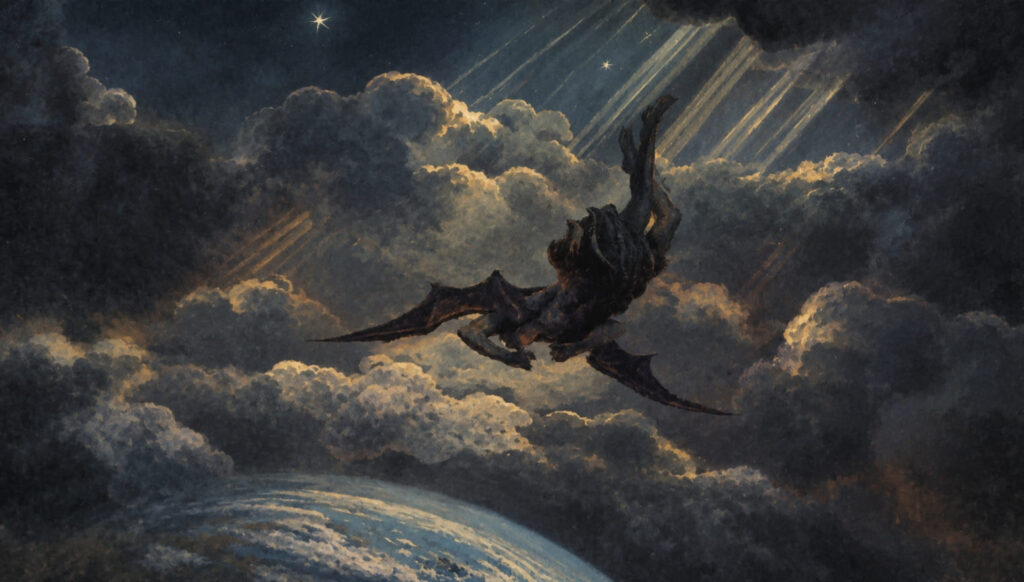
The Fall Of Satan. “I beheld Satan as lightning fall from heaven.” Luke 10:18.
1. With whom did sin originate?
“He that committeth sin is of the devil; for the devil sinneth from the beginning.” 1 John 3:8.
NOTE.—Without the Bible, the question of the origin of evil would remain unexplained.
2. From what time has the devil been a murderer?
“Ye are of your father the devil, and the lusts of your father ye will do. He was a murderer from the beginning, and abode not in the truth, because there is no truth in him.” John 8:44.
3. What is the devil’s relationship to lying?
“When he speaketh a lie, he speaketh of his own: for he is a liar, and the father of it.” Same verse.
4. Was Satan created sinful?
“Thou wast perfect in thy ways from the day that thou wast created, till iniquity was found in thee.” Eze. 28:15.
NOTE.—This, and the statement in John 8:44, that he “abode not in the truth,” show that Satan was once perfect, and in the truth. Peter speaks of “the angels that sinned” (2 Peter 2:4); and Jude refers to “the angels which kept not their first estate” (Jude 6); both of which show that these angels were once in a state of sinlessness and innocence.
5. What further statement of Christ seems to lay the responsibility for the origin of sin upon Satan and his angels?
“Then shall He say also unto them on the left hand, Depart from Me, ye cursed, into everlasting fire, prepared for the devil and his angels.” Matt. 25:41.
6. What led to Satan’s sin, rebellion, and downfall?
“Thine heart was lifted up because of thy beauty, thou hast corrupted thy wisdom by reason of thy brightness.” Eze. 28:17. “Thou hast said in thine heart, I will ascend into heaven, I will exalt my throne above the stars of God: I will sit also upon the mount of the congregation, in the sides of the north: … I will be like the Most High.” Isa. 14:13, 14.
NOTE.—In a word, pride and self-exaltation led to Satan’s downfall, and for these there is no justification or adequate excuse. “Pride goeth before destruction, and a haughty spirit before a fall.” Prov. 16:18. Hence, while we may know of the origin, cause, character, and results of evil, no good or sufficient reason or excuse can be given for it. To excuse it is to justify it; and the moment it is justified it ceases to be sin. All sin is a manifestation of selfishness in some form, and its results are the opposite of those prompted by love. The experiment of sin will result finally in its utter abandonment and banishment forever, by all created intelligences, throughout the entire universe of God. Only those who foolishly and persistently cling to sin will be destroyed with it. The wicked will then “be as though they had not been” (Obadiah 16), and the righteous shall “shine as the brightness of the firmament,” and “as the stars forever and ever.” Dan. 12:3. “Affliction shall not rise up the second time.” Nahum 1:9. See reading on “Origin, History, and Destiny of Satan,” page 499.
7. In contrast with the pride and self-exaltation exhibited by Satan, what spirit did Christ manifest?
“Who, being in the form of God, thought it not robbery to be equal with God: but made Himself of no reputation, and took upon Him the form of a servant, and was made in the likeness of men: and being found in fashion as a man, He humbled Himself, and became obedient unto death, even the death of the cross.” Phil. 2:6-8.
8. After man had sinned, how did God show His love, and His willingness to forgive?
“For God so loved the world, that He gave His Only begotten Son, that whosoever believeth in Him should not perish, but have everlasting life.” John 3:16.
NOTE.—Inasmuch as God, who is love, who delights in mercy, and who changes not, offered pardon and granted a period of probation to man when he sinned, it is but reasonable to conclude that a like course was pursued toward the heavenly intelligences who first sinned, and that only those who persisted in sin, and took their stand in open revolt and rebellion against God and the government of heaven, were finally cast out of heaven. Rev. 12:7-9.
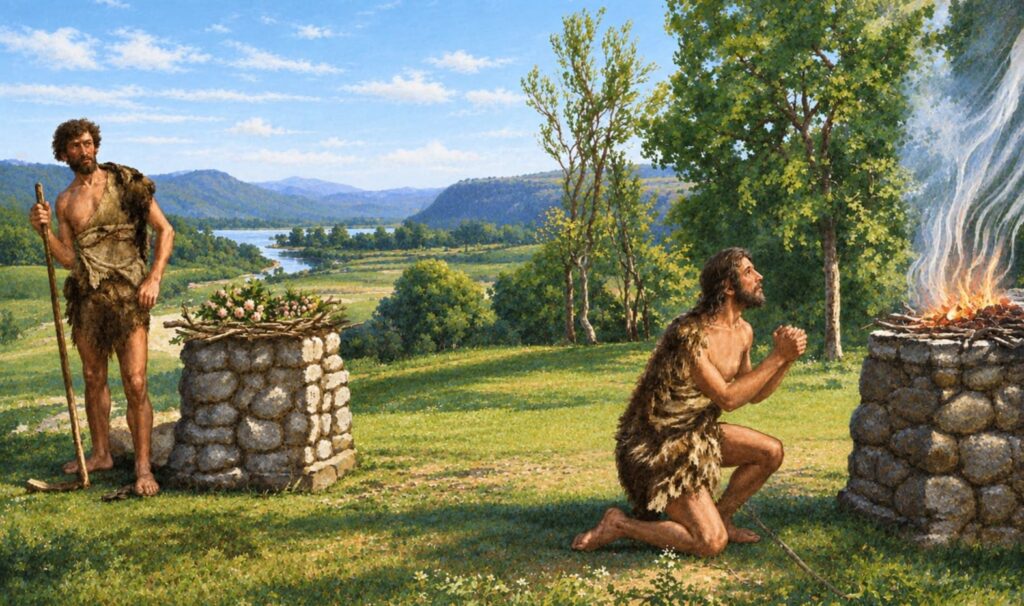
Cain And Abel–The First Murder. “Cain, who was of that wicked one, and slew his brother.” 1 John 3:12.
The Fall And Redemption Of Man
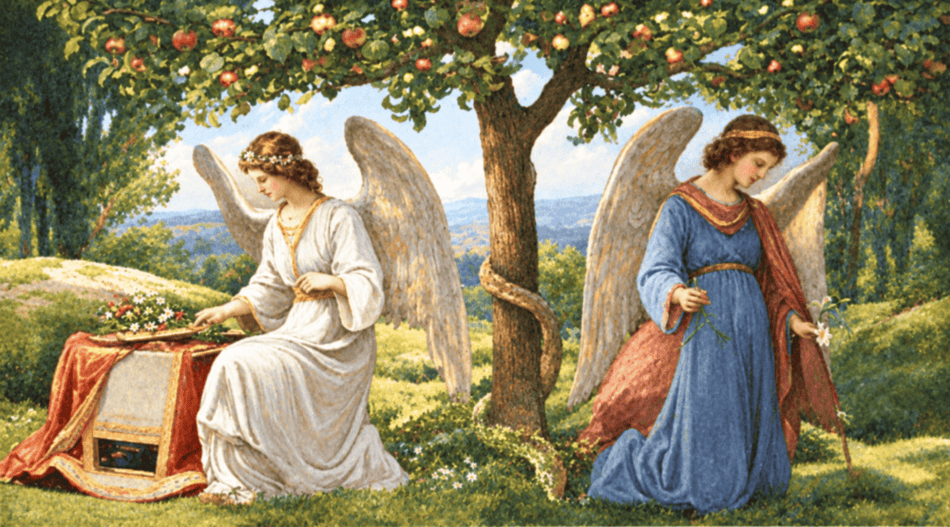
Sin And Its Remedy. “The wages of sin is death; but the gift of God is eternal life through Jesus Christ our Lord.” Rom. 6:23.
1. What is sin declared to be?
“Whosoever committeth sin transgresseth also the law: for sin is the transgression of the law.” 1 John 3:4.
2. What precedes the manifestation of sin?
“Then when lust hath conceived, it bringeth forth sin.” James 1:15.
3. What is the final result or fruit of sin?
“And sin, when it is finished, bringeth forth death.” Same verse. “The wages of sin is death.” Rom. 6:23.
4. Upon how many of the human race did death pass as the result of Adam’s transgression?
“By one man sin entered into the world, and death by sin; and so death passed upon all men, for that all have sinned.” Rom. 5:12. “In Adam all die.” 1 Cor. 15:22.
5. How was the earth itself affected by Adam’s sin?
“Cursed is the ground for thy sake; in sorrow shalt thou eat of it all the days of thy life; thorns also and thistles shall it bring forth to thee.” Gen. 3:17, 18.
6. What additional curse came as the result of the first murder?
“And the Lord said unto Cain, … And now art thou cursed from the earth, which hath opened her mouth to receive thy brother’s blood from thy hand; when thou tillest the ground, it shall not henceforth yield unto thee her strength.” Gen. 4:9-12.
7. What terrible judgment came in consequence of continued sin and transgression against God?
“And the Lord said, I will destroy man whom I have created from the face of the earth…. The end of all flesh is come before Me; for the earth is filled with violence.” “And Noah was six hundred years old when the flood of waters was upon the earth…. The same day were all the fountains of the great deep broken up, and the windows of heaven were opened.” Gen. 6:7-13; 7:6-11.
8. After the flood, what came in consequence of further apostasy from God?
“And the Lord came down to see the city and the tower, which the children of men builded. And the Lord said, Behold, the people is one, and they have all one language; and this they begin to do: and now nothing will be restrained from them, which they have imagined to do. Go to, let Us go down, and there confound their language, that they may not understand one another’s speech. So the Lord scattered them abroad from thence upon the face of all the earth: and they left off to build the city.” Gen. 11:5-8.
9. Into what condition has sin brought the entire creation?
“For we know that the whole creation groaneth and travaileth in pain together until now.” Rom. 8:22.
10. What explains God’s apparent delay in dealing with sin?
“The Lord is not slack concerning His promise, as some men count slackness; but is long-suffering to us-ward, not willing that any should perish, but that all should come to repentance.” 2 Peter 3:9.
11. What is God’s attitude toward the sinner?
“For I have no pleasure in the death of him that dieth, saith the Lord God: wherefore turn yourselves, and live ye.” Eze. 18:32.
12. Can man free himself from the dominion of sin?
“Can the Ethiopian change his skin, or the leopard his spots? then may ye also do good, that are accustomed to do evil.” Jer. 13:23.
13. What place has the will in determining whether man shall have life?
“And the Spirit and the bride say, Come. And let him that heareth say, Come. And let him that is athirst come. And whosoever will, let him take the water of life freely.” Rev. 22:17.
14. To what extent has Christ suffered for sinners?
“He was wounded for our transgressions, He was bruised for our iniquities: the chastisement of our peace was upon Him; and with His stripes we are healed.” Isa. 53:5.
15. For what purpose was Christ manifested?
“And we know that He was manifested to take away our sins; and in Him is no sin…. He that committeth sin is of the devil; for the devil sinneth from the beginning. For this purpose the Son of God was manifested, that He might destroy the works of the devil.” 1 John 3:5-8.
16. What was one direct purpose of the incarnation of Christ?
“Forasmuch then as the children are partakers of flesh and blood, He also Himself likewise took part of the same; that through death He might destroy him that had the power of death, that is, the devil.” Heb. 2:14.
17. What triumphant chorus will mark the end of the reign of sin?
“And every creature which is in heaven, and on the earth, and under the earth, and such as are in the sea, and all that are in them, heard I saying, Blessing, and honor, and glory, and power, be unto Him that sitteth upon the throne, and unto the Lamb forever and ever.” Rev. 5:13.
18. When and by what means will the effects of sin be removed?
“But the day of the Lord will come as a thief in the night; in the which the heavens shall pass away with a great noise, and the elements shall melt with fervent heat, the earth also, and the works that are therein shall be burned up.” 2 Peter 3:10.
19. How will the curse of the confusion of tongues be brought to an end?
“For then will I turn to the people a pure language, that they may all call upon the name of the Lord, to serve Him with one consent.” Zeph. 3:9.
20. How thoroughly will the effects of sin be removed?
“And God shall wipe away all tears from their eyes; and there shall be no more death, neither sorrow, nor crying, neither shall there be any more pain: for the former things are passed away.” Rev. 21:4. “And there shall be no more curse: but the throne of God and of the Lamb shall be in it [the holy city]; and His servants shall serve Him.” Rev. 22:3.
21. Will sin and its evil results ever appear again?
“What do ye imagine against the Lord? He will make an utter end: affliction shall not rise up the second time.” Nahum 1:9. “There shall be no more death.” “And there shall be no more curse.” Rev. 21:4; 22:3.
NOTE.—That sin exists none can deny. Why it was permitted has perplexed many minds. But He who can bring light out of darkness (2 Cor. 4:6), make the wrath of man to praise Him (Ps. 76:10), and turn a curse into a blessing (Deut. 23:5), can bring good out of evil, and turn mistakes and downfalls into stepping-stones to higher ground. Heaven will be happier for the sorrows of earth. “Sorrows remembered sweeten present joy,” says Robert Pollock, in “The Course of Time,” page 29. In the final outcome it will be seen that all things have worked together for good to them that love God. Rom. 8:28.
Creation And Redemption

Creative Power. “For we are His workmanship, created in Christ Jesus unto good works.” Eph. 2:10.
1. What is revealed concerning God in the first verse of the Bible?
“In the beginning God created the heaven and the earth.” Gen. 1:1.
2. What contrast is repeatedly drawn in the Scriptures between the true God and false gods?
“Thus shall ye say unto them, The gods that have not made the heavens and the earth, even they shall perish from the earth, and from under these heavens…. The portion of Jacob is not like them: for He is the former of all things; and Israel is the rod of His inheritance: The Lord of hosts is His name.” Jer. 10:11-16. See Jer. 14:22; Acts 17:22-29; Rev. 14:6-10.
3. Through whom did God work in creating all things?
“In the beginning was the Word, and the Word was with God, and the Word was God. The same was in the beginning with God. All things were made by Him; and without Him was not anything made that was made.” John 1:1-3.
4. Through whom is redemption wrought?
“But God commendeth His love toward us, in that, while we were yet sinners, Christ died for us. Much more then, being now justified by His blood, we shall be saved from wrath through Him.” Rom. 5:8, 9.
5. In what scripture do we learn that Christ, the active agent in creation, is also the head of the church?
“For by Him were all things created, that are in heaven, and that are in earth, visible and invisible, whether they be thrones, or dominions, or principalities, or powers: all things were created by Him, and for Him: and He is before all things, and by Him all things consist. And He is the head of the body, the church: who is the beginning, the first-born from the dead; that in all things He might have the preeminence.” Col. 1:16-18.
6. What scripture shows that the Creator is also the Redeemer?
“But now thus saith the Lord that created thee, O Jacob, and He that formed thee, O Israel, Fear not: for I have redeemed thee, I have called thee by thy name; thou art Mine.” Isa. 43:1.
7. Who is declared to be the source of power to the weak?
“Hast thou not known? hast thou not heard, that the everlasting God, the Lord, the Creator of the ends of the earth, fainteth not, neither is weary? there is no searching of His understanding. He giveth power to the faint; and to them that have no might He increaseth strength.” Isa. 40:28, 29.
8. What prayer of David shows that he regarded redemption as a creative work?
“Create in me a clean heart, O God; and renew a right spirit within me.” Ps. 51:10.
9. Who keeps the heavenly bodies in their places?
“To whom then will ye liken Me, or shall I be equal? saith the Holy One. Lift up your eyes on high, and behold who hath created these things, that bringeth out their host by number: He calleth them all by names by the greatness of His might, for that He is strong in power; not one faileth.” Isa. 40:25, 26.
10. What can the same Holy One do for the believer?
“Now unto Him that is able to keep you from falling, and to present you faultless before the presence of His glory with exceeding joy, to the only wise God our Saviour, be glory and majesty, dominion and power, both now and ever. Amen.” Jude 24, 25.
11. What is the measure of the power which is available for the help of the believer?
“That the God of our Lord Jesus Christ, the Father of glory, may give unto you the spirit of wisdom and revelation in the knowledge of Him: the eyes of your understanding being enlightened; that ye may know what is the hope of His calling, and what the riches of the glory of His inheritance in the saints, and what is the exceeding greatness of His power to us ward who believe, according to the working of His mighty power, which He wrought in Christ, when He raised Him from the dead, and set Him at His own right hand in the heavenly places.” Eph. 1:17-20.
12. How great was the deliverance of Israel from Egyptian bondage?
“Ask now of the days that are past, which were before thee, since the day that God created man upon the earth, and ask from the one side of heaven unto the other, whether there hath been any such thing as this great thing is, or hath been heard like it?… Hath God assayed to go and take Him a nation from the midst of another nation, by temptations, by signs, and by wonders, and by war, and by a mighty hand, and by a stretched out arm, and by great terrors, according to all that the Lord your God did for you in Egypt before your eyes?” Deut. 4:32-34.
NOTE.—The great deliverance of Israel from bondage and oppression in Egypt is but a type of the power of God displayed in the deliverance of man from the bondage and slavery of sin. In both is seen a manifestation of creative power.
13. What scripture plainly states that it is creative power which transforms the believer?
“For we are His workmanship, created in Christ Jesus unto good works, which God hath before ordained that we should walk in them.” Eph. 2:10.
14. Of what great work is the Sabbath both a memorial and a sign?
“Remember the Sabbath day, to keep it holy. Six days shalt thou labor, and do all thy work: but the seventh day is the Sabbath of the Lord thy God: in it thou shalt not do any work, thou, nor thy son, nor thy daughter, thy man servant, nor thy maid servant, nor thy cattle, nor thy stranger that is within thy gates: for in six days the Lord made heaven and earth, the sea, and all that in them is, and rested the seventh day: wherefore the Lord blessed the Sabbath day, and hallowed it.” Ex. 20:8-11. “It is a sign between Me and the children of Israel forever: for in six days the Lord made heaven and earth, and on the seventh day He rested, and was refreshed.” Ex. 31:17.
15. Inasmuch as creation and redemption are both wrought by the same creative power, of what besides the original creation was the Sabbath given to be a sign?
“Moreover also I gave them My Sabbaths, to be a sign between Me and them, that they might know that I am the Lord that sanctify them.” Eze. 20:12.
16. Through whose agency is the material universe sustained?
“And He [Christ] is before all things, and in Him all things hold together.” Col. 1:17, R. V., margin.
17. What statement shows that all things, both material and spiritual, are sustained by the same personal agency?
“But to us there is … one Lord Jesus Christ, by whom are all things, and we by Him.” 1 Cor. 8:6.
18. Why is God worthy to receive glory and honor?
“Thou art worthy, O Lord, to receive glory and honor and power: for Thou hast created all things, and for Thy pleasure they are and were created.” Rev. 4:11.
NOTE.—That comparatively modern view of creation known as evolution, which rests upon human research rather than upon divine revelation, and which substitutes an impersonal force for a personal Creator, overthrows the very foundation of the gospel. Redemption is simply the new creation, and the Creator is the Redeemer. The Head of the original creation is the Head of the new creation. The original creation was wrought through Christ by the power of the word; the new creation, or redemption, is wrought in exactly the same way. The evolutionary theory of creation inevitably involves an evolutionary theory of the gospel, and sets aside the truth concerning sin, the atoning sacrifice of Christ, and the necessity of becoming new creatures through faith in the saving power of Christ.
The Character And Attributes Of God
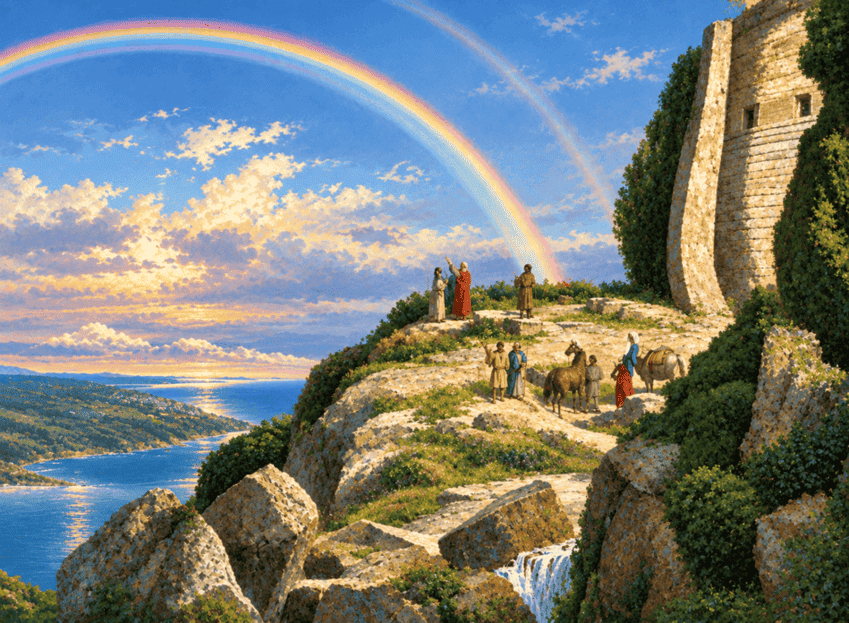
The Bow Of Promise. “This is the token of the covenant.” Gen. 9:17.
1. In what one word is the character of God expressed?
“He that loveth not knoweth not God; for God is love.” 1 John 4:8.
2. What are some of the attributes of God?
“The Lord is righteous in all His ways, and holy in all His works.” Ps. 145:17.
3. Does Christ possess these same attributes?
“By His knowledge shall My righteous servant [Christ] justify many.” Isa. 53:11. “Neither wilt Thou suffer Thine Holy One to see corruption.” Acts 2:27.
4. When proclaiming His name to Moses, how did the Lord define His character?
“And the Lord descended in the cloud, and stood with him there, and proclaimed the name of the Lord. And the Lord passed by before him, and proclaimed, The Lord, The Lord God, merciful and gracious, long-suffering, and abundant in goodness and truth, keeping mercy for thousands, forgiving iniquity and transgression and sin, and that will by no means clear the guilty.” Ex. 34:5-7.
5. What is said of the tender compassion of God?
“But Thou, O Lord, art a God full of compassion, and gracious, long-suffering, and plenteous in mercy and truth.” Ps. 86:15.
6. What is said of God’s faithfulness in keeping His promises?
“Know therefore that the Lord thy God, He is God, the faithful God, which keepeth covenant and mercy with them that love Him and keep His commandments to a thousand generations.” Deut. 7:9.
7. What is said of the strength and wisdom of God?
“Behold, God is mighty, and despiseth not any: He is mighty in strength and wisdom.” Job 36:5.
8. What treasures are hid in Christ?
“In whom are hid all the treasures of wisdom and knowledge.” Col. 2:3.
9. In what language is the justice of God described?
“He is the Rock, His work is perfect: for all His ways are judgment: a God of truth and without iniquity, just and right is He.” Deut. 32:4.
10. In what words is His impartiality proclaimed?
“For the Lord your God is God of gods, and Lord of lords, a great God, a mighty, and a terrible, which regardeth not persons, nor taketh reward.” Deut. 10:17. “Then Peter opened his mouth, and said, Of a truth I perceive that God is no respecter of persons: but in every nation he that feareth Him, and worketh righteousness, is accepted with Him.” Acts 10:34, 35.
11. To how many is the Lord good?
“The Lord is good to all: and His tender mercies are over all His works.” Ps. 145:9.
12. Why did Christ tell us to love our enemies?
“But I say unto you, Love your enemies, bless them that curse you, do good to them that hate you, and pray for them which despitefully use you, and persecute you; that ye may be the children of your Father which is in heaven: for He maketh His sun to rise on the evil and on the good, and sendeth rain on the just and on the unjust.” Matt. 5:44, 45.
13. How perfect does Christ tell His followers to be?
“Be ye therefore perfect, even as your Father which is in heaven is perfect.” Verse 48.
The Love Of God
The Burial Of Christ. “God so loved the world, that He gave His only begotten Son.” John 3:16.
1. What is God declared to be?
“God is love.” 1 John 4:16.
2. How great is God’s love for the world?
“For God so loved the world, that He gave His only begotten Son, that whosoever believeth in Him should not perish, but have everlasting life.” John 3:16.
3. In what act especially has God’s love been manifested?
“In this was manifested the love of God toward us, because that God sent His only begotten Son into the world, that we might live through Him.” 1 John 4:9.
4. In what does God delight?
“Who is a God like unto Thee, that pardoneth iniquity, and passeth by the transgression of the remnant of His heritage? He retaineth not His anger forever, because He delighteth in mercy.” Micah 7:18.
5. How are His mercies continually manifested?
“It is of the Lord’s mercies that we are not consumed, because His compassions fail not. They are new every morning: great is Thy faithfulness.” Lam. 3:22, 23.
6. Upon how many does God bestow His blessings?
“He maketh His sun to rise on the evil and on the good, and sendeth rain on the just and on the unjust.” Matt. 5:45
7. What did Jesus say of the one who loves Him?
“He that loveth Me shall be loved of My Father, and I will love him, and will manifest Myself unto him.” John 14:21.
8. Into what relationship to God does His love bring us?
“Behold, what manner of love the Father hath bestowed upon us, that we should be called the sons of God.” 1 John 3:1.
9. How may we know that we are the sons of God?
“For as many as are led by the Spirit of God, they are the sons of God…. The Spirit itself beareth witness with our spirit, that we are the children of God.” Rom. 8:14-16.
10. How is the love of God supplied to the believer?
“And hope maketh not ashamed; because the love of God is shed abroad in our hearts by the Holy Ghost which is given unto us.” Rom. 5:5.
11. In view of God’s great love to us, what ought we to do?
“Beloved, if God so loved us, we ought also to love one another.” 1 John 4:11.
12. With what measure of love should we serve others?
“Hereby perceive we the love of God, because He laid down His life for us: and we ought to lay down our lives for the brethren.” 1 John 3:16.
13. What exhortation is based upon Christ’s love for us?
“And walk in love, as Christ also hath loved us, and hath given Himself for us an offering and a sacrifice to God for a sweet-smelling savor.” Eph. 5:2.
14. Upon what ground does God’s work for sinners rest?
“But God, who is rich in mercy, for His great love wherewith He loved us, even when we were dead in sins, hath quickened us together with Christ, (by grace ye are saved;) and hath raised us up together, and made us sit together in heavenly places in Christ Jesus.” Eph. 2:4-6. See Titus 3:5, 6.
15. In what other way is God’s love sometimes shown?
“For whom the Lord loveth He chasteneth, and scourgeth every son whom He receiveth.” Heb. 12:6.
16. In view of God’s great love, what may we confidently expect?
“He that spared not His own Son, but delivered Him up for us all, how shall He not with Him also freely give us all things?” Rom. 8:32
Bearing The Cross. “Yea, I have loved thee with an everlasting love.” Jer. 31:3.
17. What is God’s love able to do for His children?
“Nevertheless the Lord thy God would not harken unto Balaam; but the Lord thy God turned the curse into a blessing unto thee, because the Lord thy God loved thee.” Deut. 23:5.
18. When men appreciate God’s love, what will they do?
“How excellent is Thy loving-kindness, O God! therefore the children of men put their trust under the shadow of Thy wings.” Ps. 36:7.
19. How enduring is God’s love for us?
“The Lord hath appeared of old unto me, saying, Yea, I have loved thee with an everlasting love: therefore with loving-kindness have I drawn thee.” Jer. 31:3.
20. Can anything separate the true child of God from the love of God?
“For I am persuaded, that neither death, nor life, nor angels, nor principalities, nor powers, nor things present, nor things to come, nor height, nor depth, nor any other creature, shall be able to separate us from the love of God, which is in Christ Jesus our Lord.” Rom. 8:38, 39.
21. Unto whom will the saints forever ascribe praise?
“Unto Him that loved us, and washed us from our sins in His own blood, … to Him be glory and dominion forever and ever.” Rev. 1:5, 6.
The Deity Of Christ
Raising The Widow’s Son. “In Him dwelleth all the fulness of the Godhead bodily.” Col. 2:9.
1. How has the Father shown that His Son is one person of the Godhead?
“But unto the Son He saith, Thy throne, O God, is forever and ever: a scepter of righteousness is the scepter of Thy kingdom.” Heb. 1:8.
2. In what other scripture is the same truth taught?
“In the beginning was the Word, and the Word was with God, and the Word was God.” John 1:1.
3. In what way did Christ refer to the eternity of His being?
“And now, O Father, glorify Thou Me with Thine own self with the glory which I had with Thee before the world was.” John 17:5. “But thou, Bethlehem Ephratah, though thou be little among the thousands of Judah, yet out of thee shall He come forth unto Me that is to be ruler in Israel; whose goings forth have been of old, from everlasting.” Micah 5:2. See margin; and Matt. 2:6; John 8:58; Ex. 3:13, 14.
4. How was Christ begotten in the flesh?
“And the angel answered and said unto her, The Holy Ghost shall come upon thee, and the power of the Highest shall overshadow thee: therefore also that holy thing which shall be born of thee shall be called the Son of God.” Luke 1:35.
5. What scripture states that the Son of God was God manifested in the flesh?
“In the beginning was the Word, and the Word was with God, and the Word was God.” “And the Word was made flesh, and dwelt among us, (and we beheld His glory, the glory as of the only begotten of the Father,) full of grace and truth.” John 1:1, 14.
6. What does Christ say is His relation to the Father?
“I and My Father are one.” John 10:30.
7. How was He manifested on earth as a Saviour?
“For unto you is born this day in the city of David a Saviour, which is Christ the Lord.” Luke 2:11.
8. Why was it necessary that He should be born thus, and partake of human nature?
“Wherefore in all things it behooved Him to be made like unto His brethren, that He might be a merciful and faithful high priest in things pertaining to God, to make reconciliation for the sins of the people.” Heb. 2:17.
9. How was He recognized by the Father while on earth?
“And lo a voice from heaven, saying, This is My beloved Son, in whom I am well pleased.” Matt. 3:17.
10. What shows that Christ sustains the same relation to the angels as does the Father?
“For the Son of man shall come in the glory of His Father with His angels; and then He shall reward every man according to his works.” Matt. 16:27. See Matt. 24:31.
11. How did Christ assert an equal proprietorship with His Father in the kingdom?
“The Son of man shall send forth His angels, and they shall gather out of His kingdom all things that offend, and them which do iniquity.” Matt. 13:41.
12. To whom do the elect equally belong?
“And shall not God avenge His own elect, which cry day and night unto Him, though He bear long with them?” Luke 18:7. “And He [the Son of man] shall send His angels with a great sound of a trumpet, and they shall gather together His elect from the four winds, from one end of heaven to the other.” Matt. 24:31.
13. Who are equally joined in bestowing the final rewards?
“But without faith it is impossible to please Him [God, the Father]: for he that cometh to God must believe that He is, and that He is a rewarder of them that diligently seek Him.” Heb. 11:6. “For the Son of man shall come in the glory of His Father with His angels; and then He shall reward every man according to his works.” Matt. 16:27.
NOTE.—In the texts (Matt. 16:27; 13:41; 24:31) in which Christ refers to the angels as “His angels” and to the kingdom as “His kingdom” and to the elect as “His elect,” He refers to Himself as “the Son of man.” It thus appears that while He was on earth as a man, He recognized His essential deity and His equality with His Father in heaven.
14. What fullness dwells in Christ?
“For in Him dwelleth all the fullness of the Godhead bodily.” Col. 2:9.
15. What does God (Jehovah) declare Himself to be?
“Thus saith the Lord the King of Israel, and His Redeemer the Lord of hosts; I am the first, and I am the last; and beside me there is no God.” Isa. 44:6.
16. In what scripture does Christ adopt the same expression?
“And, behold, I come quickly; and My reward is with Me, to give every man according as his work shall be. I am Alpha and Omega, the beginning and the end, the first and the last.” Rev. 22:12, 13.
17. Having such a wonderful Saviour, what are we exhorted to do?
“Seeing then that we have a great high priest, that is passed into the heavens, Jesus the Son of God, let us hold fast our profession. For we have not an high priest which cannot be touched with the feeling of our infirmities; but was in all points tempted like as we are, yet without sin.” Heb. 4:14, 15.
Prophecies Relating To Christ
The Star Of Bethlehem. “There shall come a Star out of Jacob.” Num. 24:17.
1. Whom did Moses say the Lord would raise up?
“The Lord thy God will raise up unto thee a Prophet from the midst of thee, of thy brethren, like unto me; unto Him ye shall harken.” Deut. 18:15. See also verse 18.
2. What use of this prophecy by the apostle Peter shows that it referred to Christ?
“For Moses truly said unto the fathers, A prophet shall the Lord your God raise up unto you of your brethren, like unto me… Yea, and all the prophets from Samuel and those that follow after, as many as have spoken, have likewise foretold of these days.” Acts 3:22-24.
3. In what language did Isaiah foretell Christ’s birth?
“Behold, a virgin shall conceive, and bear a son, and shall call His name Immanuel.” Isa. 7:14.
4. In what event was this prophecy fulfilled?
“Now all this was done [the birth of Jesus of the Virgin Mary], that it might be fulfilled which was spoken of the Lord by the prophet, saying, Behold, a virgin shall be with child, and shall bring forth a son, and they shall call His name Emmanuel, which being interpreted is, God with us.” Matt. 1:22, 23.
5. Where was the Messiah to be born?
“But thou, Bethlehem Ephratah, though thou be little among the thousands of Judah, yet out of thee shall He come forth unto Me that is to be ruler in Israel.” Micah 5:2.
6. When was Jesus born?
“Jesus was born in Bethlehem of Judea in the days of Herod the king.” Matt. 2:1.
7. Under what striking emblem was He prophesied of by Balaam?
“There shall come a Star out of Jacob, and a Scepter shall rise out of Israel.” Num. 24:17.
8. In what scripture does Christ apply the same emblem to Himself?
“I am the root and the offspring of David, and the bright and morning star.” Rev. 22:16. See also 2 Peter 1:19; Rev. 2:28.
9. What prophecy was fulfilled in the slaughter of the children of Bethlehem?
“Then Herod, when he saw that he was mocked of the wise men, was exceeding wroth, and sent forth, and slew all the children that were in Bethlehem, and in all the coasts thereof, from two years old and under, according to the time which he had diligently inquired of the wise men. Then was fulfilled that which was spoken by Jeremy the prophet, saying, In Rama was there a voice heard, lamentation, and weeping, and great mourning, Rachel weeping for her children, and would not be comforted, because they are not.” Matt. 2:16-18.
10. How was Christ’s first advent to be heralded?
“The voice of him that crieth in the wilderness, Prepare ye the way of the Lord, make straight in the desert a highway for our God.” Isa. 40:3.
11. By whom was this fulfilled?
“And this is the record of John, when the Jews sent priests and Levites from Jerusalem to ask him, Who art thou?… he said, I am the voice of one crying in the wilderness, Make straight the way of the Lord, as said the prophet Esaias.” John 1:19-23.
12. How was Christ to be received by His own people?
“He is despised and rejected of men; a man of sorrows, and acquainted with grief: and we hid as it were our faces from Him; He was despised, and we esteemed Him not.” Isa. 53:3.
Christ Before Pilate. “He was oppressed, and He was afflicted, yet He opened not His mouth.” Isa. 53:7.
13. How is the fulfillment of this prophecy recorded?
“He was in the world, and the world was made by Him, and the world knew Him not. He came unto His own, and His own received Him not.” John 1:10, 11.
14. What was predicted of Christ’s preaching?
“The Spirit of the Lord God is upon Me; because the Lord hath anointed Me to preach good tidings unto the meek; he hath sent Me to bind up the broken-hearted, to proclaim liberty to the captives, and the opening of the prison to them that are bound.” Isa. 61:1.
15. What application did Jesus make of this prophecy?
“And He came to Nazareth, where He had been brought up: and, as His custom was, He went into the synagogue on the Sabbath day, and stood up for to read. And there was delivered unto Him the book of the prophet Esaias. And when He had opened the book, He found the place where it was written, The Spirit of the Lord is upon Me, because He hath anointed Me to preach the gospel to the poor; He hath sent Me to heal the broken-hearted, to preach deliverance to the captives, and recovering of sight to the blind, to set at liberty them that are bruised…. And He began to say unto them, This day is this scripture fulfilled in your ears.” Luke 4:16-21. See Luke 7:19-22.
16. How, according to prophecy, was Christ to conduct Himself when on trial?
“He was oppressed, and He was afflicted, yet He opened not His mouth: He is brought as a lamb to the slaughter, and as a sheep before her shearers is dumb, so He openeth not His mouth.” Isa. 53:7.
17. When accused by His enemies before Pilate, how did Christ treat these accusations?
“Then said Pilate unto Him, Hearest Thou not how many things they witness against Thee? And He answered him to never a word; insomuch that the governor marveled greatly.” Matt. 27:13, 14.
18. What prophecy foretold of the disposal of Christ’s garments at the crucifixion?
“They part My garments among them, and cast lots upon My vesture.” Ps. 22:18.
19. What record answers to this prophecy?
“And they crucified Him, and parted His garments, casting lots: that it might be fulfilled which was spoken by the prophet, They parted My garments among them, and upon My vesture did they cast lots.” Matt. 27:35.
20. What was foretold of His treatment while on the cross?
“They gave Me also gall for My meat; and in My thirst they gave Me vinegar to drink.” Ps. 69:21.
21. What was offered Christ at His crucifixion?
“They gave Him vinegar to drink mingled with gall: and when He had tasted thereof, He would not drink.” Matt. 27:34. See also John 19:28-30, and page 167 of this work.
22. With whom did the prophet Isaiah say Christ would make His grave?
“And He made His grave with the wicked, and with the rich in His death.” Isa. 53:9.
23. With whom was Christ crucified?
“Then were there two thieves crucified with Him, one on the right hand, and another on the left.” Matt. 27:38.
24. Who took charge of Christ’s body after it was taken down from the cross?
“A rich man of Arimathaea, named Joseph, … went to Pilate, and begged the body of Jesus…. He wrapped it in a clean linen cloth, and laid it in his own new tomb, which he had hewn out in the rock.” Verses 57-60.
25. What experience in the life of a noted prophet indicated the length of Christ’s stay in the grave?
“But He answered and said unto them, An evil and adulterous generation seeketh after a sign; and there shall no sign be given to it, but the sign of the prophet Jonas: for as Jonas was three days and three nights in the whale’s belly; so shall the Son of man be three days and three nights in the heart of the earth.” Matt. 12:39, 40.
26. What prophecy foretold Christ’s triumph over death?
“For Thou wilt not leave My soul in hell; neither wilt Thou suffer Thine Holy One to see corruption.” Ps. 16:10. See Acts 2:24-27.
Christ The Way Of Life
At Jacob’s Well. “Whosoever drinketh of the water that I shall give him shall never thirst.” John 4:14.
1. What does Jesus declare Himself to be?
“Jesus saith unto him, I am the way, the truth, and the life: no man cometh unto the Father, but by Me.” John 14:6.
2. In what condition are all men?
“But the Scripture hath concluded all under sin.” Gal. 3:22. “For all have sinned, and come short of the glory of God.” Rom. 3:23.
3. What are the wages of sin?
“The wages of sin is death.” Rom. 6:23.
4. How many are affected by Adam’s transgression?
“Wherefore, as by one man sin entered into the world, and death by sin; and so death passed upon all men.” Rom. 5:12.
5. What is the gift of God?
“The gift of God is eternal life.” Rom. 6:23.
6. How many may receive this gift?
“And the Spirit and the bride say, Come. And let him that heareth say, Come. And let him that is athirst come. And whosoever will, let him take the water of life freely.” Rev. 22:17.
7. In whom is the gift?
“This is the record, that God hath given to us eternal life, and this life is in His Son.” 1 John 5:11.
8. In receiving the Son, what do we have in Him?
“He that hath the Son hath life.” Verse 12.
9. What loss do those sustain who do not accept Him?
“And he that hath not the Son of God hath not life.” Same verse.
10. In what other way is this same truth stated?
“He that believeth on the Son hath everlasting life: and he that believeth not the Son shall not see life; but the wrath of God abideth on him.” John 3:36.
11. After one truly receives Christ, whose life will be manifested in him?
“I am crucified with Christ: nevertheless I live; yet not I, but Christ liveth in me: and the life which I now live in the flesh I live by the faith of the Son of God, who loved me, and gave Himself for me.” Gal. 2:20.
12. In what condition are all before they are quickened with Christ?
“God, who is rich in mercy, for His great love wherewith He loved us, even when we were dead in sins, hath quickened us together with Christ.” Eph. 2:4, 5.
13. What is this change from death to life called?
“Being born again, not of corruptible seed, but of incorruptible, by the word of God, which liveth and abideth forever.” 1 Peter 1:23.
14. When man first transgressed, what was done to prevent him from living forever in sin?
“And now, lest he put forth his hand, and take also of the tree of life, and eat, and live forever…. So He drove out the man; and He placed at the east of the garden of Eden cherubim, and a flaming sword which turned every way, to keep the way of the tree of life.” Gen. 3:22-24.
15. What is declared to be one purpose of Christ’s death?
“Forasmuch then as the children are partakers of flesh and blood, He also Himself likewise took part of the same; that through death He might destroy him that had the power of death, that is, the devil.” Heb. 2:14.
16. Through whom will Abraham receive the promise of the future inheritance?
“The Lord appeared unto Abram, and said, Unto thy seed will I give this land.” Gen. 12:7.
17. How many were embraced in God’s promises to Abraham?
“And in thy seed shall all the kindreds of the earth be blessed.” Acts 3:25.
18. To whom does the “seed” in these promises refer?
“Now to Abraham and his seed were the promises made. He saith not, And to seeds, as of many; but as of one, And to thy seed, which is Christ.” Gal. 3:16.
19. What would make the death of Christ in vain?
“If righteousness come by the law, then Christ is dead in vain.” Gal. 2:21.
20. Why have all been reckoned under sin?
“But the Scripture hath concluded all under sin, that the promise by faith of Jesus Christ might be given to them that believe.” Gal. 3:22.
21. How then do all become children of God?
“For ye are all the children of God by faith in Christ Jesus.” Verse 26.
22. With whom are the children of God joint heirs?
“If children, then heirs; heirs of God, and joint heirs with Christ.” Rom. 8:17.
The Serpent In The Wilderness. “When he beheld the serpent of brass, he lived.” Num. 21:9.
Salvation Only Through Christ
On The Cross. “He is able to save to the uttermost.” Heb. 7:25.
1. For what purpose did Christ come into the world?
“This is a faithful saying, and worthy of all acceptation, that Christ Jesus came into the world to save sinners.” 1 Tim. 1:15.
2. Why was He to be named “Jesus”?
“Thou shalt call His name Jesus: for He shall save His people from their sins.” Matt. 1:21.
3. Is there salvation through any other?
“Neither is there salvation in any other: for there is none other name under heaven given among men, whereby we must be saved.” Acts 4:12.
4. Through whom are we reconciled to God?
“All things are of God, who hath reconciled us to Himself by Jesus Christ, and hath given to us the ministry of reconciliation; to wit, that God was in Christ, reconciling the world unto Himself, not imputing their trespasses unto them.” 2 Cor. 5:18, 19.
5. What has Christ been made for us, and for what purpose?
“For He hath made Him to be sin for us, who knew no sin; that we might be made the righteousness of God in Him.” Verse 21.
6. How dependent are we upon Christ for salvation?
“I am the vine, ye are the branches: … without Me ye can do nothing.” John 15:5.
7. What three essentials for a Saviour are found in Christ?
Deity. “But unto the Son He saith, Thy throne, O God, is forever and ever.” Heb. 1:8.
Humanity. “When the fullness of the time was come, God sent forth His Son, made of a woman, made under the law.” Gal. 4:4.
Sinlessness. “Who did no sin, neither was guile found in His mouth.” 1 Peter 2:22.
8. How did Christ show from the Scriptures that the promised Saviour of the world must be both human and divine?
“While the Pharisees were gathered together, Jesus asked them, saying, What think ye of Christ? whose son is He? They say unto Him, The son of David. He saith unto them, How then doth David in spirit call Him Lord; saying, The Lord said unto my Lord, Sit Thou on My right hand, till I make Thine enemies Thy footstool? If David then call Him Lord, how is He his son?” Matt. 22:41-45.
NOTE.—Another has aptly put this important truth concerning the union of the human and divine in Christ thus: “Divinity needed humanity that humanity might afford a channel of communication between God and man. Man needs a power out of and above himself to restore him to the likeness of God. There must be a power working from within, a new life from above, before men can be changed from sin to holiness. That power is Christ.”
9. What two facts testify to the union of divinity and humanity in Christ?
“Concerning His Son Jesus Christ our Lord, which was made of the seed of David according to the flesh; and declared to be the Son of God with power, according to the spirit of holiness, by the resurrection from the dead.” Rom. 1:3, 4
10. How complete was Christ’s victory over death?
“I am the first and the last: I am He that liveth, and was dead; and, behold, I am alive forevermore, Amen; and have the keys of hell and of death.” Rev. 1:17, 18. See Acts 2:24.
11. How complete is the salvation obtained in Christ?
“Wherefore, He is able also to save them to the uttermost that come unto God by Him, seeing He ever liveth to make intercession for them.” Heb. 7:25.
12. What should we say for such a Saviour?
“Thanks be unto God for His unspeakable gift.” 2 Cor. 9:15.